

Don’t Forget to EEAT: Why Brands Can No Longer Ignore the Importance of EEAT Factors
EEAT is more important than ever in AI search. Find out why experience, expertise, authority and trust shape brand visibility today.
Authored by Tyeish Liburd | 23rd July 2026EEAT (Experience, Expertise, Authority and Trust) is perhaps the acronym that remains most crucial to those seeking to optimise content for search.
Thanks to the recent rise of AI, chatbots and LLM-driven queries, its core principles have never been more important.
In this article, we’ll explore why EEAT remains essential in the age of AI, and how neglecting it may be hurting your business.
In summary:
- EEAT remains vital in the age of AI-powered search. AIOs and LLM-powered services such as ChatGPT continue to prioritise content that demonstrates genuine experience, expertise, authority and trustworthiness.
- LLMs tend to favour content that goes the extra mile, offering high-quality, authoritative information that completely satisfies user intent. This typically includes features such as valuable original content with a clear structure, FAQs, and rich media.
- User Generated Content (UGC) platforms such as Reddit and Trustpilot are becoming increasingly influential in AI search, as more and more users visit these sites for authentic, first-hand accounts on products, services and experiences.
Why EEAT matters to AIOs and LLMs
The emergence of AI-powered search has left many agencies and brands scrambling for shiny new methods and strategies.
Indeed, Conductor’s research revealed that nearly one-third of digital marketing leaders now focus on generative engine optimisation (GEO) as the most critical performance hurdle for digital growth.
But while exploring aspects such as AI search prompts can certainly be an important part of this, EEAT remains a central pillar of best practice that underpins GEO as well as SEO.
The shift in behaviour
Consumers tend not to scroll through results and click on links anymore; they’re getting what they need from summaries and Large Language Model (LLM) responses.
Instead of focusing on blue ticks in Google, brands now seek to be cited directly inside an AI-generated summary or answer.
You now need to ensure your brand and its content features prominently in AI overviews (AIOs), and in LLM searches that bypass traditional search engines altogether.
- According to QuickSEO, AIOs appear in approximately 25% to 50% of all Google searches, and this is only likely to increase.
- In the US, roughly half of all adults now use LLMs like ChatGPT. Worldwide, it is thought that more than one billion people use AI tools each month. It’s now an AI world, people, and we’re just living in it.
The key thing to remember, however, is that LLMs are looking for detailed and clear answers to user queries. They want original, high-quality content that’s backed up by accurate facts and reliable stats. And that’s why EEAT still has serious skin in this game.
Let’s take a look at each element of EEAT, and explore their role in GEO moving forward.
Experience: FAQs and rich media
LLMs value authors with first-hand experience on the topic they’re writing about – and so do audiences. Content grounded in genuine experience tends to be trusted more, and this can boost the likeliness of it being included in AI search responses.
Authentic, original insights offer real value to audiences, while FAQs provide an opportunity to offer users a variety of information on a topic, covering a wide range of related queries.
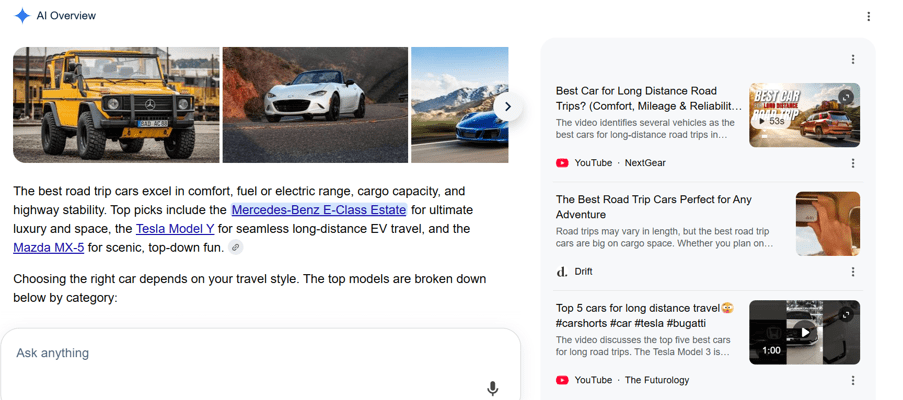
The use of rich media such as images and video can also showcase experience in more visible ways, and make content more digestible. In fact, video content is being captured and cited at an increasing rate, especially by AIOs.
YouTube sources currently make up a large portion of AI Overview citations: 18% of AIO citations originate from YouTube, and 5.6% of all AI Overview citations are now videos taken directly from the platform.
Perhaps unsurprisingly, YouTube citations have grown by 34% over the last six months alone – so it’s clear that it’s a resource that Google is tapping into.
Expertise: specialist authors, facts and stats
This element refers to expert voices, well-researched information and credibly sourced facts and statistics.
Businesses should continue to focus on creating original, high-quality, detailed content that’s accurate and supported by trusted sources and statistics. You should aim to showcase industry knowledge and offer expert insights to provide users with valuable information.
AI responses searches often split a user’s query into a number of sub-queries to deliver a more detailed response: known as ‘fan-out queries’.
You want to not only answer their main question, but also cover secondary fan-out queries for a comprehensive approach.
Here are a few features content should ideally include for GEO and SEO optimisation:
- A clear and concise question and answer format
- Content that’s directly targeted at the ideal audience and their search intent
- Relevant information for the search query
- Easily digestible content – e.g. use of numbered and bullet lists
As well as the above, websites should also include author bylines and references to demonstrate the expertise behind the facts, statistics, and insights. Providing detail on the writer's credentials, editorial role, and expertise helps to add transparency and brings a personal touch and credibility to the content. It also helps to boost the level of trust readers have in what’s being said.
A few websites do this particularly well, for example, financial advice website Nerd Wallet author bylines and bios across their articles – highlighting all the writers involved in content creation.
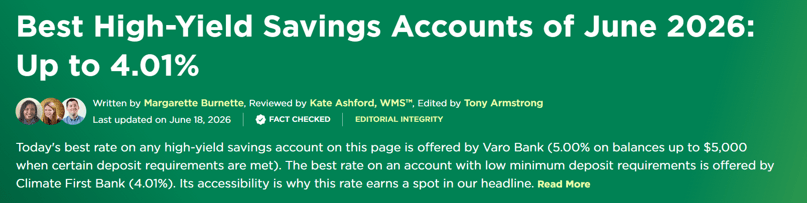
Readers can click on each byline to learn more about the writer, with each bio featuring:
- Writer editorial role
- Writer specialist topics
- Quotes
- Background
- Latest articles
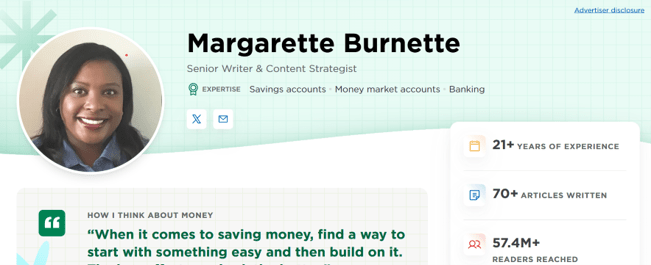
This is an excellent example of how websites can demonstrate expertise and gain reader trust. By clearly identifying the author, showcasing their qualifications and experience, websites provide greater transparency and reassure users that the information has been created by professionals.
Authority: linking and topic depth
Authority is built through reputation and recognition. It signals to both Google and audiences that you’re a reliable source on a particular topic.
One of the main ways to demonstrate authority to search engines and LLMs is backlinks, citations and brand mentions – and not just from anyone. Effective ‘shout-outs’ come from trusted websites themselves. Think official government websites, well-known news publications and websites with high domain authority.
A study by SEMrush revealed that domains with stronger backlink authority are mentioned more often in AI-generated answers. These backlinks help Google determine whether a brand, website or author is seen as a reliable source within its industry. Being recognised by other key players in your field can strengthen your credibility with Google — and ultimately with audiences too.
Internal linking for added depth
Internal linking can also play a key role in the success of your website pages. Search engines tend to reward websites that demonstrate a deep understanding of the subject matter with links to other related topics, rather than just isolated articles that only target individual keywords.
Creating a comprehensive network of content around a topic helps establish authority and signals to readers and LLMs that your website is a credible, trusted source of information.
Trust: UGC, Reviews and Reddit
Trust plays a key part in almost every element of the modern search framework. Brands that are trusted by customers, positively regarded on social platforms, and provide robust, useful information on relevant topics can expect LLMs and AIOs to cite their website more widely.
Trust has motivated clicks and conversions for years, and it’s not going away anytime soon.
- Signals including industry and consumer awards and accreditations help to demonstrate reliability, while reviews, testimonials and customer perspectives play a major role in mentions and citation selection.
- Indeed, User Generated Content (UGC) sites like Reddit increasingly dominate AI search results – with Reddit accounting for 40% of citations in AI-generated responses, outweighing Wikipedia, YouTube and Google results combined.
PR specialist Joel Lodge gave his opinion on the topic of UGC sites in the AI search landscape:
“LLMs treat Reddit communities as a more trustworthy source than a business blog or on-site content.
“Reddit forums and threads are important as they're more likely to appear as a source, as they show what real customers and product users are saying about your brand, rather than what your own site claims.”
A prime example showcasing the influence of UGC is a search for the “best PDF converter” on Google. The AI overview ranks iLovePDF as the top choice for quick, free online tasks and cites a Reddit page.
Reddit themselves backs this perspective, with Jen Wong, Chief Operating Officer stating: "In a world of AI, there’ s a lot more AI driven content that's really crowded the internet - people recognise that what Reddit offers stands out more.
"The internet has become a place that maybe isn't all that human in authenticity which was maybe the original promise… but Reddit has preserved that."
The cost of neglecting EEAT
LLMs and AIO responses thrive on strong, detailed and digestible content that:
- Features robust FAQs
- Is bolstered by facts and stats
- Includes expert insight and sources
- Comes from trustworthy and credible brands.
Failing to execute or maintain EEAT best practices will cause brands to fall behind in the modern search landscape. Even if they achieve decent traditional rankings, they may be pushed further down in SERP results; or skipped altogether when information is surfaced without a SERP being involved.
Becoming experts in EEAT
Bringing Experience, Expertise, Authority and Trust to bear across SEO, content and outreach campaigns remains a valuable part of any comprehensive search strategy.
Identifying areas for improvement, and enacting changes to boost visibility in AI and organic search, can help brands be a discoverable force in an ever-competitive and shifting landscape.
At KINESSO, we use our proprietary TRAQ framework, part of Omnicom’s AI Optix suite of tools, to assess how advanced a brand’s answer engine strategy is.
Using more than 200 weighted indicators, it provides a holistic view of performance across the factors that shape visibility in both organic and AI search, helping brands identify opportunities for improvement and stay ahead of competitors. Get in touch with us to find out more about our services.