
Google’s UCP Update: How Ecommerce Brands Can Prepare for the Future of SEO
Google’s Universal Commerce Protocol is reshaping SEO for ecommerce by enabling AI agents to discover, trust and complete purchases on your site.
Authored by Callum Steenson | 19th February 2026In January, Google announced the Universal Commerce Protocol (UCP) - one of the most meaningful shifts in the relationship between search, SEO, and ecommerce in over a decade.
UCP signals Google’s intent to support a future where AI agents don’t simply recommend products, but also complete purchases on a user’s behalf. This has direct implications for how SEO is defined, measured, and executed moving forward.
What Is Google’s Universal Commerce Protocol (UCP)?
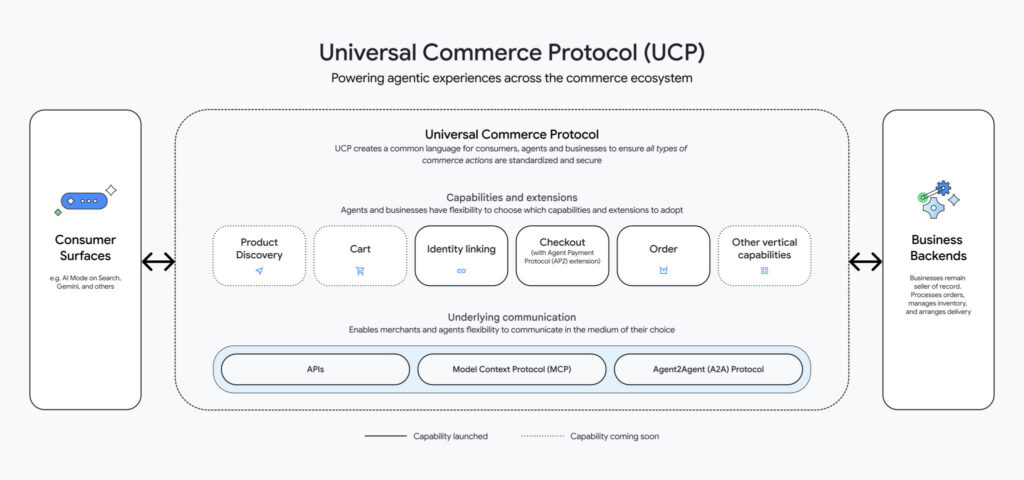
UCP is an open commerce standard designed to let AI agents interact directly with retailer systems across the full shopping journey.
That includes:
- Product discovery
- Evaluation and comparison
- Checkout and payment
- Post-purchase support
All without requiring bespoke, one-off integrations for each platform or agent.
Google has co-developed UCP alongside major commerce players like Shopify, Etsy, Wayfair, and Target, with wider industry adoption already underway.
Why Is This Happening Now?
From Google’s perspective, this move is both defensive and inevitable.
As AI-powered assistants become a primary interface for high-intent queries, Google won’t want to risk losing commercial intent to external platforms. UCP allows Google to keep discovery, decision-making, and transactions within its ecosystem, while still positioning itself as “open” to retailers.
In short, if shopping is going to happen inside AI conversations, Google intends to be there.
What Changes for SEO Right Now?
In the short term, UCP does not replace traditional SEO fundamentals. But it raises the bar on areas SEO teams already influence.
Today, SEO for ecommerce increasingly determines whether your products are:
- Eligible to appear in AI-driven discovery
- Trusted enough for an agent to recommend
- Technically capable of supporting agent-led checkout
Key areas of immediate impact and focus include:
- Merchant Center quality: Accurate, complete, and policy-compliant feeds are now table stakes, not hygiene.
- Structured data consistency: Pricing, availability, shipping, returns, and product identifiers must align perfectly across site, feeds, and APIs.
- Entity and trust signals: Clear brand identity, transparent policies, and strong off-site reputation directly influence whether agents are willing to transact.
SEO is no longer about helping Google understand what you sell; it’s about enabling AI agents to decide whether they can rely on you.
The Bigger Shift: From Rankings to Transactions
Historically, ecommerce SEO has focused on ranking pages to drive traffic. UCP expands that scope.
In an agentic commerce model, success depends on whether an AI agent can:
- Discover your product
- Understand it with confidence
- Trust your merchant data
- Complete a transaction without friction
If any one of those steps fails, visibility becomes irrelevant.
This is where SEO evolves from a channel into a commerce enablement function, sitting closer to product data, engineering, and operations than ever before.
Clicks Matter Less Than Ever
One of the most important implications of UCP is measurement.
Agent-led purchases may happen:
- Inside AI Mode in Search
- Within Gemini
- Without a traditional website visit
That means:
- Sessions and clicks become incomplete success metrics
- Client-side analytics will miss part of the picture
- Revenue attribution must increasingly rely on server-side and backend data
For SEO leaders, this creates a responsibility to reset expectations internally. Visibility, influence, and revenue impact matter more than traffic volume alone.
What This Means for the Future of SEO
Looking ahead, UCP accelerates trends that were already in motion.
SEO will increasingly focus on:
- Data clarity over content volume
- Capability-based discoverability, not just page rankings
- Cross-functional collaboration with engineering, legal, and operations
- AI-first optimisation, where content and feeds serve both humans and agents
This is not the end of SEO. It’s an expansion of its mandate.
Brands that adapt early will show up where decisions are made, even if fewer of those decisions involve a traditional SERP click.
Final Thoughts
Google’s Universal Commerce Protocol is not a switch that flips overnight. Adoption will be gradual, and consumer behaviour will take time to change.
But the direction is clear.
SEO is moving upstream, closer to revenue, trust, and transaction enablement. For ecommerce brands, the question is no longer if AI agents will influence purchase decisions, but whether your data, systems, and SEO strategy are ready for when they do.
At KINESSO UK&I, we see UCP as a pivotal moment for SEO to lead – shaping how trust, transactions, and discovery work in the next phase of digital commerce.
You can explore the technical foundations, published by Google here: